We earn a commission if you apply and are approved. This does not affect our recommendations.
Officially sourced — Amex Platinum fee $895 and Chase Sapphire Reserve fee $795 verified against issuer pages, November 2026. Credit amounts and guest policies change — check current terms at americanexpress.com and chase.com. Last reviewed: November 2026.
Last reviewed: November 2026
Amex Platinum vs Chase Sapphire Reserve in 2026
By Hank Cai, Founder · Last reviewed: November 2026 · 8-min read
Quick Answer
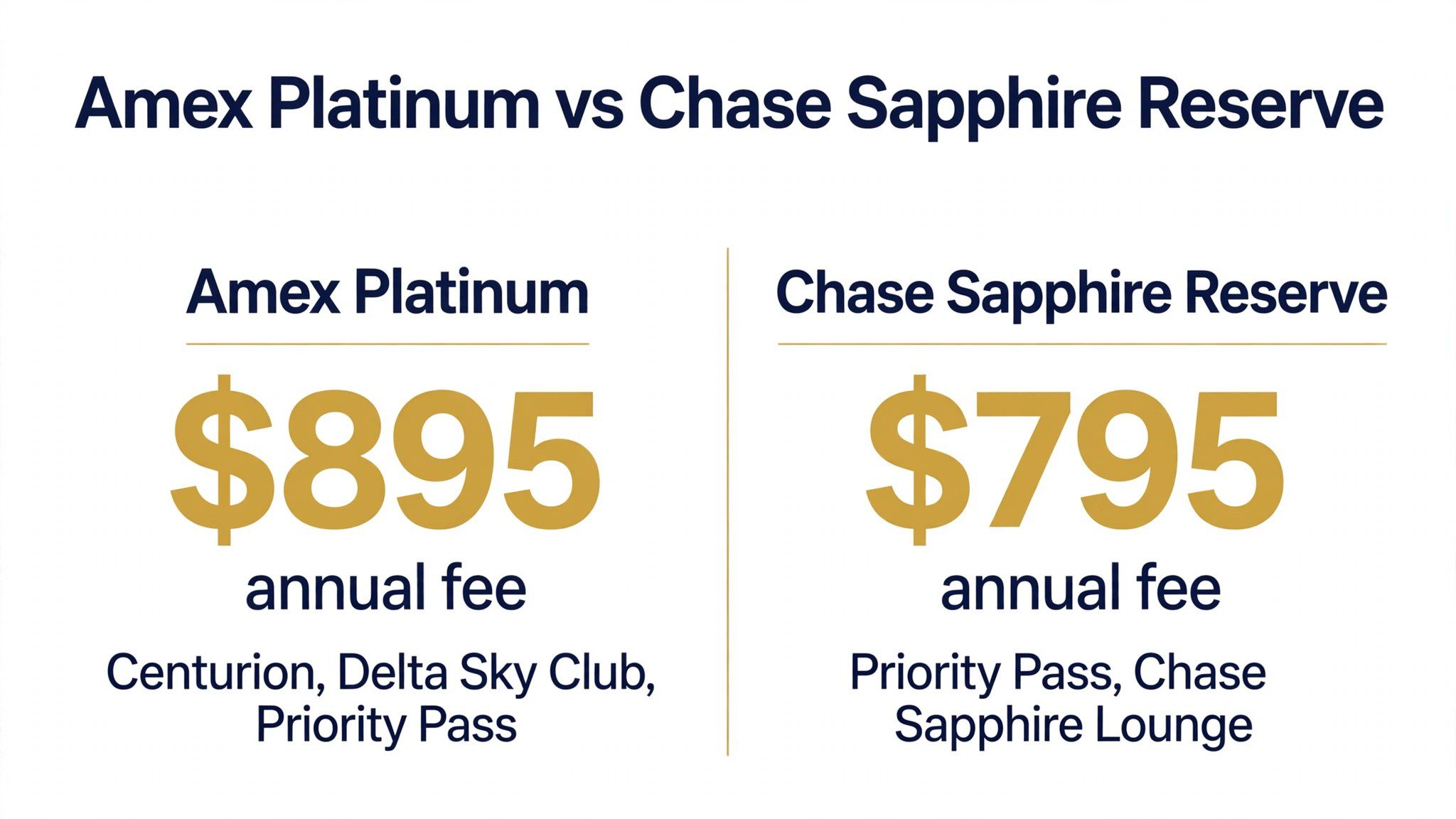
The Amex Platinum ($895 a year) wins on lounge breadth: Centurion Lounges, 10 Delta Sky Club visits a year, and 1,500+ Priority Pass lounges. The Chase Sapphire Reserve ($795 a year, $495 after its $300 travel credit) wins on simplicity, with eight Sapphire Lounges and easier credits. Choose Platinum for Delta and Centurion; choose Reserve for simple value.
Our Verdict
This is a genuinely close call.
The Amex Platinum wins on lounge network breadth: Centurion is the best domestic lounge product, and the Platinum opens 1,500+ locations globally through Priority Pass, Delta Sky Club, Escape, and Plaza Premium. If your airports of choice have Centurion Lounges and you fly Delta often, the Platinum is the better card.
The Chase Sapphire Reserve wins on simplicity and dining quality. The $300 travel credit is the easiest premium card credit to capture — it posts against almost any travel charge. Travelers report the Sapphire Lounge food compares well with the nearest Centurion alternative at the same airports. The CSR’s $795 annual fee is $100 lower than the Platinum’s $895, and $495 after the $300 travel credit, so the effective fee is more predictable.
The deciding question: Do you fly regularly through airports with Centurion Lounges, and will you use Delta Sky Club access? If yes to both, Amex Platinum. If you mostly want a great lounge at your specific airports and a simple fee structure, CSR.
Head-to-Head Comparison
| Feature | Amex Platinum | Chase Sapphire Reserve |
|---|---|---|
| Annual fee | $895 | $795 |
| Annual travel credit | Airline fee credit, hotel credit, entertainment credit, CLEAR credit and others — amounts change; check current amounts at americanexpress.com | $300 travel credit, broad eligible categories (check current eligible categories at chase.com) |
| Effective annual fee | Roughly $300 to $500 depending on credits used (estimate — credit amounts change) | $495 after the $300 travel credit |
| Centurion Lounges | Yes (35+ locations) | No |
| Chase Sapphire Lounges | No | Yes (8 locations: BOS, JFK, LGA, LAS, PHL, PHX, SAN, IAD) |
| Delta Sky Club | 10 visits/year when flying Delta | No |
| Priority Pass | Select, unlimited visits, no restaurant redemptions | Select, unlimited visits (check current restaurant-partner terms at chase.com) |
| Priority Pass guest policy | Check current guest policy at americanexpress.com | Check current guest policy at chase.com |
| Sapphire Lounge guest count | N/A | Check current guest policy at chase.com |
| Centurion guest fee | $50/adult, $30/child (ages 2-17), max 2 | N/A |
| Lufthansa Lounges | Access ended September 30, 2026 | No |
| Escape Lounges | Yes | No |
| Plaza Premium | Yes | No |
| Transfer partners | Amex Membership Rewards (19 partners) | Chase Ultimate Rewards (14 partners) |
| Additional / authorized user fee | $195 for additional Platinum cards | $195 per authorized user |
| Global Entry credit | $120 (Global Entry $120; TSA PreCheck $78 new / $85 renewal) | $120 (Global Entry $120; TSA PreCheck $78 new / $85 renewal) |
The Fee Math
Amex Platinum at $895:
The Platinum’s credits include an airline fee credit, a hotel credit, an entertainment credit, a CLEAR credit, and others. Credit amounts change — check the current amounts at americanexpress.com before applying. Cardholders who use the airline and hotel credits reliably land at roughly $300 to $400 in effective annual cost. The challenge: credits are siloed across specific categories and services, requiring deliberate spending to capture.
Travelers report using only some of the available credits, which puts the practical effective fee at roughly $250 to $400 per year for an engaged holder.
Chase Sapphire Reserve:
The CSR’s $300 travel credit applies broadly to travel purchases (check the current eligible categories at chase.com). No airline-specific credit, no portal requirement, no service-specific bucketing — it just posts against travel. If you pay for a hotel, flight, rideshare, or similar expense, the credit typically applies. After the credit, the effective annual fee is $495.
The CSR’s credit is the most frequently cited advantage in traveler comparisons: cardholders report capturing it in the first billing cycle without any change in spending habits.
Net comparison: The Amex Platinum’s maximum credit value is higher, but the CSR’s credit is easier to capture. For travelers who do not want to manage a multi-bucket credit structure, the CSR effective fee is more predictable.
Lounge Network Comparison
Where the Amex Platinum is clearly better:
- Centurion Lounges (35+ locations): The Platinum is the only consumer card that gets you into Centurion Lounges. These are the best domestic airport lounges by consistent community ranking: full hot dining, full bars, showers at most locations, dedicated agent assistance. If you fly regularly through JFK, LAX, MIA, SFO, ORD, DFW, ATL, LAS, SEA, or CLT, the Centurion is accessible.
- Delta Sky Club (10 visits/year): No other non-Delta card includes Sky Club access.
- Network breadth globally: 1,500+ lounges through combined networks (Priority Pass, Escape, Plaza Premium). Lufthansa lounge access ended September 30, 2026.
Where the Chase Sapphire Reserve is competitive or better:
- Sapphire Lounge food quality: At the two airports where both a Centurion Lounge and a Sapphire Lounge are present (JFK, LAS), travelers report the Chase Sapphire Lounge food compares well with the Centurion. The Sapphire Lounge uses a restaurant-and-bar model with table service and a curated menu. The experience is closer to a sit-down restaurant than a buffet.
- Guest policy: Check the current Sapphire Lounge guest policy at chase.com before planning a trip with guests. Centurion charges $50 per adult guest.
- Priority Pass restaurant redemptions: Amex Platinum Priority Pass does NOT include restaurant redemptions. For the CSR, check the current restaurant-partner terms at chase.com.
- Simplicity: One Priority Pass tier for all locations. The Platinum’s Priority Pass excludes restaurants, which creates a two-tier experience that some cardholders find confusing at airport restaurants.
Transfer Partners: Membership Rewards vs Ultimate Rewards
If you use points for flights, this comparison matters as much as the lounge question.
Amex Membership Rewards (Platinum): 19 airline transfer partners including Delta SkyMiles, Air Canada Aeroplan, ANA, British Airways Avios, Air France/KLM Flying Blue, Singapore Airlines KrisFlyer, and others. Amex points transfer at 1:1 to most partners. No hotel partners with outsized redemption value for domestic travelers.
Chase Ultimate Rewards (Sapphire Reserve): 14 partners including United MileagePlus, Air Canada Aeroplan, British Airways Avios, Hyatt, Marriott, IHG, and others. Chase points transfer at 1:1. The Hyatt transfer is one of the strongest hotel redemptions in points programs: a 30,000-point free night at a Hyatt Category 7 property can return 3 to 5 cents per point, well above cash value.
The practical difference: Amex is stronger for international airline partners (Delta domestic, ANA transcontinental, Flying Blue transatlantic). Chase is stronger for hotel redemptions through Hyatt and for United loyalists. Neither is strictly better — it depends on which airlines you fly and where you want hotel redemptions.
When to Pick Each Card
Choose the Amex Platinum if:
- Your airports of choice have Centurion Lounges and you will use them on most trips
- You fly Delta regularly and want Sky Club access (10 visits/year when flying Delta same day)
- You travel internationally on Amex Membership Rewards airline partners (ANA, Flying Blue, Singapore)
- You will realistically use enough credits to bring the effective fee below $400
- You want the widest lounge network globally
Choose the Chase Sapphire Reserve if:
- You fly regularly through Boston, JFK, LGA, Las Vegas, Philadelphia, Phoenix, San Diego, or Washington Dulles (Sapphire Lounge cities)
- You want the simplest travel credit — one $300 credit against any travel purchase
- You have existing Chase Ultimate Rewards points or hold other Chase cards
- Hyatt hotel redemptions matter to you
- You want free guest access at proprietary lounges without per-guest fees
- You prefer a lower headline annual fee ($795 vs $895)
Consider holding both if:
- You are a Delta-heavy traveler who wants Sky Club access AND wants Sapphire Lounge dining at Sapphire cities
- You have Amex Membership Rewards points for international redemptions AND Chase Ultimate Rewards points for Hyatt hotels
- The combined effective fees are justified by your actual usage of both cards’ distinct benefits
What Travelers Actually Report
Travelers report a consistent split: those who value the simplest credit switch to the CSR for the $300 travel credit, which posts against the first travel purchase of the year without category management; those who fly Delta regularly or live near a Centurion Lounge stay with the Platinum for lounge breadth. Travelers also report that the Platinum’s credits take deliberate tracking to capture in full, while the CSR’s single credit is easy to use. One correction worth stating plainly: the Delta SkyMiles Reserve does not give unlimited Sky Club access — it allows 15 visits per year in 2026, with unlimited access only at $75,000 annual spend — so it is not a workaround for the Platinum’s 10-visit cap.
FAQ
Is the Amex Platinum or Chase Sapphire Reserve better for airport lounges?
The Amex Platinum gives access to a larger lounge network: 35+ Centurion Lounges, Delta Sky Club (10 visits/year when flying Delta), 1,500+ Priority Pass locations, Escape Lounges, and Plaza Premium. The Chase Sapphire Reserve has a smaller proprietary network (8 Sapphire Lounge locations) but travelers report the food quality compares well at those locations. Check the current Sapphire Lounge guest policy at chase.com before planning a trip with guests; the Amex Platinum charges $50 per adult guest at Centurion. If raw network breadth is the priority, Amex Platinum wins. If dining quality at specific cities and a simpler guest policy matter more, Chase Sapphire Reserve is competitive.Is the Chase Sapphire Reserve worth it over the Amex Platinum?
For travelers who fly regularly through Sapphire Lounge cities (Boston, JFK, LGA, Las Vegas, Philadelphia, Phoenix, San Diego, Washington Dulles) and want the simplest travel credit structure, yes. The CSR’s $300 travel credit applies broadly to travel purchases (check current eligible categories at chase.com), making it the easiest premium credit to capture. The Amex Platinum’s $895 annual fee requires managing multiple credit categories to offset. The CSR’s lower annual fee ($795 vs $895; $495 after the travel credit) and simpler credit structure make it the better choice for travelers who don’t need Centurion Lounge access or Delta Sky Club visits specifically.Can I hold both the Amex Platinum and Chase Sapphire Reserve?
Yes. Many heavy travelers hold both. The most common reason is leveraging Amex Membership Rewards for international airline redemptions and Centurion Lounge access (Amex Platinum) while using Chase Ultimate Rewards for Hyatt hotel transfers and United miles (Chase Sapphire Reserve). The combined annual fees are substantial, but cardholders who actively use both programs’ transfer partners and lounge access often report positive net value. Whether it makes sense depends on how frequently you use each card’s distinct benefits.Does the Chase Sapphire Reserve have Centurion Lounge access?
No. Centurion Lounges are exclusively accessible to Amex Platinum cardholders (and Amex Centurion cardholders). The Chase Sapphire Reserve does not include Centurion access. The CSR’s proprietary lounge is the Chase Sapphire Lounge by The Club, currently at eight US airports (Boston, JFK, LGA, Las Vegas, Philadelphia, Phoenix, San Diego, Washington Dulles). If Centurion access is the primary goal, the Amex Platinum is the only consumer card that delivers it.Which card has better transfer partners for flights — Amex or Chase?
It depends on which airlines you fly. Amex Membership Rewards has 19 airline partners, strong for Delta SkyMiles, ANA, Air France/KLM Flying Blue, and Singapore Airlines. Chase Ultimate Rewards has 14 partners, strong for United MileagePlus, Air Canada Aeroplan, and British Airways Avios. Chase also has Hyatt as a hotel transfer partner, which offers some of the best cents-per-point redemption values available. For domestic travel on Delta, Amex wins. For domestic travel on United and for Hyatt hotel redemptions, Chase wins. For transatlantic travel, both have strong options through British Airways and Flying Blue.Related Guides
- Best Card for Airport Lounge Access
- Amex Platinum Lounge Access Guide
- Chase Sapphire Reserve Lounge Access Guide
- Amex Platinum vs Capital One Venture X
- Lounge Guest Policies
- All Travel Cards